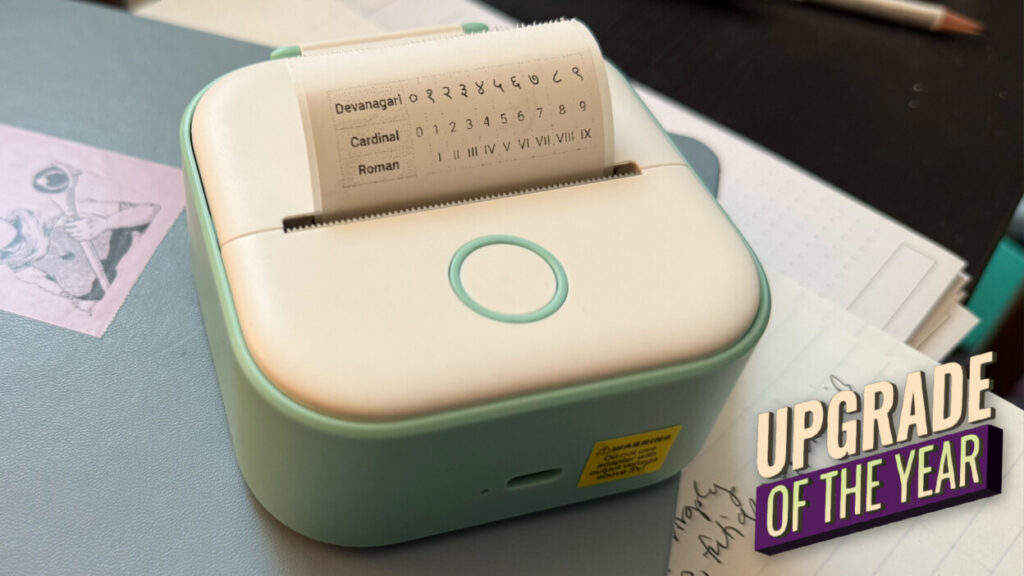
You don’t know how many times in the past few years I saw that mini thermal printers existed, considered getting one, and then decided, no, it’s too silly and I’ll never use it. Friends, I finally caved, and my only regret is not getting one earlier. I’ve only had this tiny gadget for about a month, but it’s gotten daily use in my house. With Christmas coming up, I use it to print gift tags and labels. I use custom stickers to make charts in my workout journal, and it’s even become the centerpiece of the Elf on the Shelf’s interaction with my daughter. (Yes, she still claims to believe, probably just for the entertainment value of seeing what I come up with next—desperation is the mother of creativity.)
I’m the kind of person who enjoys physical items, especially paper and notebooks, but somehow I always end up glued to my phone. Being able to print things out keeps me in the real world, especially if I can do something on paper (or a sticker) that I would normally do with an app.
What exactly is a thermal sticker printer?
You’ve seen these before, even if you don’t realize it. The receipts you get at most grocery stores and other big stores are thermally printed; so are lots of barcode and ingredient labels that might be slapped on, say, a rotisserie chicken or a box of bakery cookies.
These are “thermally” printed because there is no ink. Instead the receipts or labels are made of a coated paper that turns dark when exposed to heat. The printer just heats up the appropriate areas of the paper as it exits the machine.
Stores love these printers because the technology is old and cheap, the paper is cheap, there’s no ink to refill, and the receipts or stickers print quickly. It doesn’t really matter that the output is black-and-white and low resolution; we’re not using these for fine art.
Those features are also what I like about my mini version. The printer itself was only $25 on a Black Friday deal, and the paper rolls last forever and only cost about a dollar each. In contrast, I also own a full-color mini photo printer that uses Zink paper, and it’s the opposite: expensive paper, slow printing, and terrible battery life. The prints look pretty good, but because of these drawbacks, I almost never use it. Meanwhile, I use the thermal printer all the dang time.